I'd be remiss in not noting the sad passing of the Dramatics' Ron Banks. At this point, most of the original founders have all died in the last ten years and I don't think a single one of them made it 60.
I don't have a long post to write here - I can't say I really knew the Dramatics' catalog as deeply as that of other groups though obviously, I'm up on their big hits. I did find it fascinating that they were a Detroit group yet signed to the star of the South: Stax/Volt. Wonder if Gordy ever got pissed about that though by the early '70s, he probably had his hands busy with moving Motown to L.A. anyway. In any case, here's two songs I picked out in memmoriam: one being the Dramatics' first hit (and one of their most enduring), "Whatcha See Is Whatcha Get" and I decided to pair that with a killer reggae cover of one of their other songwriting gems, "In the Rain," done by the Debonaires (thanks to Hua for putting me up on that single).
Because I was in the middle of moving/unpacking/new house hell, I really missed out on being able to say something meaningful about the passing of Memphis legend Willie Mitchell or slow jam king Teddy Pendergrass.
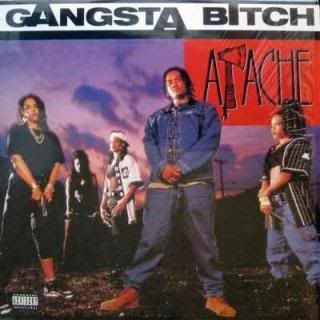
Apache may not have been a major rapper - his career came and went within a few short years in the early/mid-90s - but if he's destined to be known as a one-hit wonder, I'd argue that "Gangsta Bitch" was one of the more influential of its era. Lyrically, the song roiled many, not the least of which was putting the word "bitch" out so prominently and, if I recall, it fed into concerns (read: paranoia) about girl violence in that era; Apache was accused of encouraging female delinquency and violence, blah blah blah. From what I can remember, while there were certainly female rappers boasting about their bad ass-ness (B.O.S.S. anyone?), Apache was one of the first male rappers I could remember, besides perhaps Ice Cube, to pen an anthem to hip-hop's gangstresses. Biggie hadn't come out with "Me and My Bitch" yet, let alone the Lox's Ride or Die Bitch" or any of the subsequent songs you can think of. So there's that.
But for me, Apache's verses weren't nearly as memorable as the beat - put together by Q-TIp in one of the first non-Tribe tracks I ever remember Tip's credit appearing on (this was before he gave tracks to Mobb Deep or Nas) and it was a beauty - total classic of its era. The drums come from Lonnie Smith's excellent soul-jazz-organ-puffer "Spinning Wheel" and four bars in, Tip hits you with a loop lifted from Monty Alexander's "Love and Happiness."
Butter.
This track stays as one of my all time favorites and that's kept Apache alive in my memory for all these years. I suppose it's what will continue to even after his death.
Richard's People: Yo Yo (O-Dub's Extended Intro Edit) From 7" (Tuba, 1968)
When Doc Delay came through to spin the other month, he dropped this in the middle of a funk mix and trainspotter as I am, I craned my neck over to ask: "wtf is this?" It sounded like the unruly love child of a Midwestern funkateer backed by an East Harlem band and as I dug around for more info on its background, turned out I was more or less on point.
While the 7" came out of Detroit (rumor is, the vocalist was a janitor at Tuba Records), the backing track originated in New York which probably explains why the dip into the shing-a-ling has a distinctive Nuyorican sabor on it. Boogaloo fiend as I am, I love where Latin boogaloo comes back to the Midwest (where the booglaoo was born). It's very post-modern before anyone was talking about post-modernity(ok, I'm hella nerding out right now) but all you need to know is that "Yo Yo" rocks. Sure, it's a derivative track in terms of being a "new dance" that also borrows from any number of hit songs from the same era such as the "Cool Jerk" and "Here Comes the Judge." (Again, pastiche! Collage!) Plus, all that and a breakbeat intro? Oh hells yes. (Personally, I'd love to see how the "Yo Yo" is done; sounds like fun.)
This is jarring gear shift but I'd be remiss in not taking the time to mourn the passing of Teddy Pendergrass, gone far before this time (which is about 99% of the great ones, no?).
Teddy Pendergrass: Love TKO From TP (Philly Int'l, 1980)
All-time, end of night, slow jam, red light classic (though I suppose "Close the Door" is the king seduction song even more).
King Kong: The Love I Lost From Funky Reggae (MFP, 1970s)
Just played this out last night and cotdamn was this Harold Melvin and the Blue Notes (feat. Teddy) such an incredible jam, made all the more enticing in this reggae-fied remake.
Again, I'm really bummed I'm not fully moved in yet because between Teddy and Willie, there's so much to say about how important these soul men are. I'm sure Mark Anthony Neal will be drop something brilliant very soon.
Meanwhile, I'm THIS close to unboxing my records. Here are my new shelves with the guy who helped me build them.
It bums me out that all my soul LPs (including everything I have by Willie or produced by him) is still boxed up and not readily accessible. To be sure, we just lost one of the most important architects of American soul. Respect due. More later.
The only thing I would add is that Raida's passing was different for me from MJ and John Hughes, though those latter two men certainly played a role in defining my childhood. Raida was, for all intents and purposes, a peer, part of my "cohort." My transition into adulthood came concurrently with me becoming a DJ and being witness and participant in the larger world that DJs like Roc Raida were kings of. I mourn his death but celebrate his legacy.
Mark Anthony Neal: "That boy spent a lifetime seeking a meaningful freedom, perhaps from the tyranny of family, but later from the tyranny of celebrity. And yeah perhaps Mr. Presley, Ms. Monroe and those four British mop-tops could relate, but when that young boy was hitting his half half of them were dead—and they never had to deal with MTV and 24-hour cable networks in their prime."
Hua Hsu: "Jackson was one of the last figures of our time who could, in his very presence, describe the possibilities of pop. He wasn't just the King--he was the entire domain, the rules and regulations, the dream-horizon of the citizenry, the place where the land met the heavens. Jackson was one of the first (and last) artists whose new videos, tours and albums were actual, global events...This was the cultural history of the pre-digital age: simultaneity, mass worship, millions sitting in front of their TVs at the exact same moment. (The closest analogue now: millions around the world, sitting in front of their computers, carefully recomposing Michael's Wikipedia entry the moments after his death was made official.)"
Jeff Chang: "Long before anyone could read into Michael Jackson’s cubist, etiolated face a work of performance art, the wounds of internalized racism, or the excess of boredom and wealth, all those things that would make us either look away or gawk, there was his voice...And for that voice, he lost his childhood. Or more precisely, he gave it to us. Many of his most affecting performances were about distance and displacement, the desire to be somewhere else, the inability to return to a lost past"
Ann Powers: "I remember the inner sleeve of the Jackson 5's 1971 release "Maybe Tomorrow," one of the very first vinyl records I ever purchased. It was full of pictures of the brothers, their Afros shaped into hearts, their boyhood turned into a charm suitable for sticking onto a schoolgirl's notebook. In reality, Jackson was a black steel-mill operator's son from Indiana, no one a white accountant's daughter from Seattle would have ever met. The teen idol machine turned him into a dream friend that any girl or boy could have."
Ta-Nehisi Coates: "I remember when this came out, and all the kids who'd been lucky enough to stay up and see Friday Night Videos came to school bragging about it. You couldn't get cable in Baltimore back then. Fools were like, "Yo, every time he took a step the stones would glow! And then when he went invisible the stones kept glowing!!" We thought Mike could save us all. We hadn't heard BDP yet."
Ernest Hardy: "He was Blackness and maleness, soul music and pop culture, all forged pre-hip-hop, pre-Reagan, pre-crack, pre the implosion of short-lived Civil Rights-era idealism and hope. That’s an incalculably important point to understand the thick strands of optimism, possibility, aesthetic & political vision that ran through his work. And that makes the darkness and paranoia that marbled so much of his later work all the more heartbreaking, especially as it roughly paralleled the shifting tenor of the times. He never lost his humanitarian streak or his belief in the overall goodness of humanity, but the evolution of his own relationship to the world and his feelings about how he was treated darkened noticeably."
Hua..again: "in this moment before communication was instant and cheap, Michael was one of the most powerful access points to American culture from abroad -- his star didn't tarnish at the same rate elsewhere. Perhaps it was the wonder and magic of his music or the subversive hue of his skin that exempted him from accusations of cultural imperialism."
Jason King: "While I always felt Jackson had to dance out of the necessity of sheer ecstatic release, his younger counterparts, happy to imitate their idol, have yet to find their own original moves. Nor have any of them found a real sense of personal abandon in dance. It’s been said that Jackson did not pick up choreography easily (nor did Gene Kelly for that matter). But when he danced, he did so with fierceness, with creative risk. It was as if his life depended on it."
Greg Tate: "Michael's death was probably the most shocking celebrity curtain call of our time because he had stopped being vaguely mortal or human for us quite a while ago, had become such an implacably bizarre and abstracted tabloid creation, worlds removed from the various Michaels we had once loved so much. The unfortunate blessing of his departure is that we can now all go back to loving him as we first found him, without shame, despair, or complication. "Which Michael do you want back?" is the other real question of the hour: Over the years, we've seen him variously as our Hamlet, our Superman, our Peter Pan, our Icarus, our Fred Astaire, our Marcel Marceau, our Houdini, our Charlie Chaplin, our Scarecrow, our Peter Parker and Black Spider-Man, our Ziggy Stardust and Thin White Duke, our Little Richard redux, our Alien vs. Predator, our Elephant Man, our Great Gatsby, our Lon Chaney, our Ol' Blue Eyes, our Elvis, our Frankenstein, our ET, our Mystique, our Dark Phoenix."
(Editor's note: That whole "I'm done with MJ posts"? Ok, so that was premature. Sorry but the hits just keep on coming! This is from James Cavicchia, my favorite "music writer who is not professionally a music writer but better than many music writers who are" and a message board post he is allowing me to reprint. --O.W.)
"When I think about it, I don’t think I’ve ever been fully convinced by Michael Jackson, really. Not convinced by the squeaky-clean pre-teen singing about women troubles in every other song, not convinced by the timid good-timer of Off The Wall (though I always think of Michael dancing, I never ever think of him dancing with anyone—do you?), not convinced by the cuddly werewolf/virginal baby-daddy/china-fine gang-war mediator of Thriller, and on and on. He was never convincingly girl-weary as a young boy, and never convincingly romantic, aggressive, or sexual as an adult. He always seemed to be just outside of the real action. And while this made me feel very affectionate toward him—he was so clearly a kid, one of us, who had somehow fooled the right people and infiltrated the adult world—none of his music ever seemed to have any real place in any reality that I was familiar with. I managed to grow up loving his music without it actually meaning anything to me; it felt huge and important, but weightless. Like cartoons.
I know that sounds pretty negative, but what it actually ends up meaning is that Michael Jackson’s music works on me with a purity matched by few. Because for all the levels on which it may be suspect—lyrics, persona, whatever—there is one level on which it always always convinces: the sound. Three certainties in life: You will definitely die, you will always pay taxes, and you will never ever say “Man, that Michael Jackson song doesn’t sound as good as I remember.” It will only ever sound better, I promise you. Whatever suspension of disbelief the songs may require, and however little connection they may have to anything outside their own miniature fantasias, their reign within the borders of their runtime is absolute. They are unalloyed pop-music-production genius galvanized by Michael’s voice, which is not always the most integral piece, but is always, finally, the most necessary one. At the same time their immense commercial success keeps them present and current within culture, their essential unreality and inhuman inner perfection allow them to operate outside of time. They often seem less like actual songs and more like ideas that we’re all having at the same time. To hear them is to think, “Well, yeah—of course.”
And “I Want You Back” is the best Michael Jackson song. It’s not quite my favorite (“The Love You Save” narrowly edges it), but it’s the best, and is one of what I usually consider to be the two archetypal Perfect Pop Songs. To paraphrase T.S. Eliot (I know, right?): The Jackson 5’s “I Want You Back” and The Who’s “I Can’t Explain” divide the world between them—there is no third.
It starts with that piano curlicue that doubles back on itself before it’s even gone and tagging the guitar at the turn, the two together sounding like they could flip the entire sun like a fucking flapjack. Then the strings come in and then the bongos and then and then and then, and it’s not harmonious, exactly—there’s crisp separation between each instrument, and everything’s in its own space, but the sheer mass of all the pieces gives it this beautiful kind of overfull clatter. There’s a quick sense that not only could there not possibly be anything better, there couldn’t possibly be anything else. Mike glides down in full whine, and from here on out the song stubbornly defies momentum—it stays stopping and starting, the drums jump in place (only on the choruses, though—no drums at all on the verses), and it’s the most glorious parade in the world, too generous, and stopping at every house. It should annoy, but the thing is that after every single stop, it somehow manages—incredibly—to sound even better when it starts back up. You don’t think it will, but it does, every single time. By the end, hearts and ears bulge at the seams from the undiminished return.
And although the song never puts across the sense of loss that you’d assume from the title, it’s okay, because it’s not really trying to. The amiable bass and the daylight guitar and that plinky piano that get sprinkled in seem to understand Michael in a way that Michael doesn’t understand the song (and probably couldn't, at his age): Despite the literal desperation of the lyrics, and even though he works overtime to sell us on it, it’s clear from Michael’s perfect, explosive vocal that he does not believe even for an instant that it won’t all work out, and the genius of the music is that it recognizes that this—the faith and the gold of youth—is the point of the song, not some girl, some…other. The point is the I, not the want. Just listen to the little vocal break before the last chorus: Mike’s trying to preach it on what would ostensibly be the climax of this love-lost song, but behind him is this springy guitar line cake-walking with some easter-bunny bassline. Like I said: There's an understanding. Understanding that when Michael sings “Won’t you please let me / back in your heart?”, it isn’t actually a question.
Was it ever, really?"
-James Cavicchia
Bonus beat: Jackson 5: I Want You Back (Z-Trip Remix) From Motown Remixed Vol 1 (Motown, 2005
This is (probably) going to be the last post I'm going to do on M-J-5 for the time being, bringing to a close a rather crazy 5 day period where it was all MJ, all the time.
1) I just recorded this in the morning: The Soul Sides Kitchen-Cast w/ Ann Powers. Besides being a good friend, Ann also happens to be chief pop critic at the L.A. Times and I invited her over to talk about MJ's musical and cultural legacy in my kitchen (for the record, my green room provides Orangina and mixed nuts).
Here's the podcast in streaming form or you can download it here.
2) Wil and I recorded our Boogaloo[la] set from last Thursday which includes a 2 hour opening set that includes a good deal of lesser known J5 and MJ covers/remixes/songs. Then there was our 2 hour MJ5 set which slammed down all the "best ofs" into a party-smashing mix. You can download both:
Tribute set (Just remember this was recorded live!)
P.S.: I've been trying to figure out why I've been so compelled to stay on story over the last five days and it's certainly not out of the tabloid fascination that will only grow (and get uglier) in the weeks to come. It's the music, always the music, that keeps drawing me back in and it finally dawned on me this morning that while MJ certainly wasn't the first pop artist I heard in my lifetime, he was so utterly everywhere at my entry into the pop world that everything I love about music, about its emotional power and reach - MJ was a foremost influence. In other words, his music was one of the most important ways through which I learned to love music. And so, in paying tribute to that musical legacy, I'm really just trying to find a way to express an appreciation for a gift that, 30 years after I first shook my tush to "Don't Stop Til You Get Enough," has continued to enrich my life on a daily basis. For that gift, I will remain forever thankful for MJ's music, regardless of what I may think of the man behind them.
From the time he was 10 Michael Jackson grew up in front of the world - first wonderfully, then weirdly, then woefully. His death at just 50 is hard to quite process. A tragedy? Yes but I'm not sure if it's any more tragic than the grotesque implosion of the rest of his life. I thought Hua had it exactly right: "Different versions of Michael Jackson had already died years ago."
A similar point was echoed by my friend Eliani while we were noshing at 2am at the Taco Zone truck, following a two hour MJ5 tribute set with Wil at the Shortstop. In between bites of carnitas, she proffered (I'm paraphrasing), "depending on when you grew up, each of us has a different Michael Jackson we knew and lost."
I was lucky to have grown up with one of the incadescent MJ incarnations. I probably heard a J5 song at some point in my '70s childhood but I don't actually remember hearing a Michael Jackson song until "Don't Stop 'Till You Get Enough" and the Off the Wall album came out. I was probably 7 or 8 then, just discovering the radio and top 40 and so my exposure to the expansive world of pop was indelibly marked by his presence.
It's been an interesting process, trying to decipher what exactly made him so great. After all, and this is not meant to be remotely disrespectful, but while Jackson clearly helped sell a gazillion records, if you actually parse down his musical impact, he's overshadowed by any number of peers. Some have had a greater, overall presence on pop music (James Brown + The Beatles), others have stayed in the mix as a creative force with more consistency (Dylan), and certainly, there's been other artists just as commercially successful but more adventurous (hello Prince!).
That said, consider how a pre-pubescent child managed to score success on par with Marvin Gaye at the turn of the '60s/'70s, then gradually pull away from the machine (or if you prefer, The Corporation) that fueled his success, only to emerge into a solo career that didn't simply improve on his achievements but elevated him into the greatest pop artist of his generation.
Child singers are simply not meant to survive into adulthood. I can only think of two similar examples: Stevie Wonder comes to mind but Stevie never had the kind of instant success that the Jackson 5 provided Michael (that said, Stevie's creativity is unparalleled, including by Michael). The other would be, interestingly, Celine Dion. Do with that what you will. However, those exceptions aside, pop music history is littered with the ghosts of child singers whose careers disappeared with the onset of puberty.
Whatever the truths of Jackson's childhood (idyllic vs. tortured), what you can say is that he had to shoulder the same kind of creative challenges under the Motown system that his colleagues - thrice his age - were also dealing with. Not only that but he was expected, long before he was old enough to even drive, to emote the kind of passion, longing and melancholy that usually only repeated adult heartache gives you access to. Emotionally, he had to grow up in his singing much faster than what his physical age would otherwise belie. It's common to talk about J5 songs like "ABC" being "filled with innocence" but if you listen over the group and Jackson's solo catalog from the 1970s, there's a lot less sunshine than you'd imagine. That he managed to drop iconic, hit records throughout most of that process (with the exception of a fallow period in the mid-'70s) is a testament to his talent/genius/luck/whatever you want to call it.
And therein, to me, lies both the triumph of his achievements but also the makings of his (and in a sense, our) tragedies. As Jeff Chang argued, "for that voice, he lost his childhood. Or more precisely, he gave it to us," which isn't quite like saying he died for our sins but I think part of what Jeff is suggesting is that if Michael wasn't blessed with such a magical presence, we may not have liked him so well. And if we didn't like him so well, maybe his life would have turned out more normal, less (self)-destructive. These "what if" scenarios are impossible to answer, of course. All we know is the Jackson we were given and if his life is to be read as a kind of sacrifice to our pleasure, at least we can honor that by celebrating his libations.
Consider too: Jackson was a once-in-a-lifetime musical (and of course, cultural) figure, the likes of which will almost certainly never be duplicated again (sorry Jonas Brothers). The pop landscape has shifted, irrevocably I feel, over the last 10-20 years and the ability for a singular figure to become a multi-generational crossover star seems practically impossible. Of course, it probably seemed impossible back in the '70s...until Michael did it.
I should add too: for all his foibles, scandals and just general surreality, I absolutely guarantee you that the music Jackson and his family left behind will only evolve to seem more sublime, enchanting and moving [1].
Ok - so enough about legacy; next time I pop in, it'll be to talk about Jackson's music. In the meantime, here is arguably the most memorable performance MJ gave. It is still incredible some 26 years later.
If you feel like it, here's me and Jay Smooth musing on MJ for The Sound of Young America, recorded earlier today. The Sound of Young America
[1] This presumes there isn't some smoking gun evidence which comes out posthumously that MJ was indeed, guilty of child molestation. But even his music could likely survive that.
As I started to compose my thoughts for this piece, my jotted notes alone were close to a page-and-a-half, and I’m sure that even in those, I’m forgetting a couple of points I want to touch upon. Some people you just expect to live forever as they are almost larger than life. It’s perhaps, to me, my “where were you when you heard about Elvis’ death?” moment. With Farrah Fawcett - whose same-day death was only a matter of when given her ongoing struggle with cancer - or with legends such as James Brown or Isaac Hayes, whose careers were equally as defining and defying, but whose time out of their heyday was long gone, the announcements were not totally unexpected. Michael’s death, seemingly, came out of nowhere. There was Michael the person, and then there was Michael as a mythos, as bigger than life, as a FORCE, only one of which has expired.
A showstopper in any definition of the word, he transcended generations and racial barriers. From oldies fans who were there from the start of his career in Gary to today’s young teens, whose attention span and too-cool-for-even-last-week’s-number-one-hit musical tastes rarely wander from the MTV playlists, he rocked them all. Even as I talked to a co-worker today, she told me about her 6-year-old son who goes to bed each night playing the Jackson 5’s greatest hits CD. That’s what you call IMPACT.
He was from an ilk who could sing and perform a song with his own style and master it to a T. Perhaps most remembered for his performances, videos, and dance moves, he was a truly underappreciated singer. He sang songs with conviction (“Scream”), attitude (“Dirty Diana”), desire (“Heal The World”), a sense of longing (“Someone In The Dark”), and heartbreak (“She’s Out Of My Life”). His aforementioned style, shown in his vocal trademark hee-hees and grunts, was truly his own.
“Someone In The Dark,” an oft-forgotten song from the E.T. audiobook/soundtrack, is from his most fruitful period (the Thriller days) and may perhaps be his best vocal performance on wax as it is sung with such passion and longing of someone needing a best friend. Even today as I listened to it on my drive to work, it brought on goosebumps, the surefire sign of a remarkable performance. It was the ‘80s version to his ‘70s “Ben” in that it was based on a film whose characters, in an alien and a rat, respectively, were misunderstood creatures, not unlike Michael himself.
Even in the poignant, if a bit saccharine, “Gone Too Soon” (from Dangerous), you couldn’t help but marvel at his ability to take you to another place. The song was dedicated to fellow Hoosier Ryan White, whose battle with AIDS and being socially shunned from his small Midwestern community brought a hailstorm of national coverage, and was a subject with which Michael was all too familiar - a boy who never got to fully enjoy growing up. It’s no surprise that at song’s end you can literally hear his voice crack.
Then there are the dance hits too plentiful to name. My DJ friend Apollo calls the breakdown in “Don’t Stop Til You Get Enough” one of the baddest breakdowns in pop music history. My personal favorite dance hit “Wanna Be Startin’ Somethin’” has an undeniable energy and its African-influenced Makossa chant is the enchanter to even a non-dancer.
There was the famous moonwalk that Michael debuted at the Motown 25 Live televised celebration. Even watching it to this day KNOWING what’s about to happen, I am just as spellbound. “What? No he didn’t just do that! But how?” * Rewind * Jaws dropped worldwide and everyone was trying to learn that step the next day. I, too, tried for hours on end to learn to moonwalk, not as a child, but as a mid-20s young adult.
When was the last time you were at a party/club/wedding where you DIDN’T see someone emulate a Michael move? Several years ago at a wedding reception, family friend Chad Decker and another attendee did the entire dance sequence of the “Beat It” video, streetfight scene and all. I’m sure they hadn’t done it in years but it was so ingrained in their memories that they nailed it. The entire party seemed to stop for those 4 minutes. Afterward, people high-fived and were basking in the influence of Michael’s glow.
When talking about him, you can’t forget how he changed what a music video could be, from short form to long form. You could make an entire movie like Moonwalker. It was only earlier this week that I was talking about Captain EO. Until seeing Up 3-D, Captain EO was the last 3-D film I had seen.
I’m not even sure that the word “awesome” can encompass his talents. He was that big. But in attaining such great heights, you only have further to fall. Alluding to a follow-up comment to O.W.’s article yesterday by av2ts, it’s a country (and world) where people love to watch your meteoric rise but revel in watching the trainwreck and fall back to Earth and beyond. Too many people are eager and willing to uncover your dirt only to bury you in it, even if that means burying you alive.
His level of fame was a two-sided coin where people didn’t fully want to let go of the great memories but couldn’t quite resist to bring him down a notch or three, especially of a figure who doesn’t quite fit into their idea of normalcy. If someone has such glaring eccentricities, then surely the rumor mills can’t all be untrue. At least, that’s how we’d like to rationalize it to ourselves.
That being said, this may only be the case during his lifetime. In death, I believe the future will be kind to his legacy. For while his image was tarnished for the last 10-15 years of his life, people also love a resurrection and redemption of great icons. For all the joy he gave the world by making you feel ALIVE, these feelings can be too emotionally overbearing to dismiss. The eccentric behavior, the neverending surgeries, and the circus that was his life may end up being an asterisk on a career, and more importantly a life, that is too expansive to be summed up in a few words or thoughts.
His lonely death is symbolic in that there was perhaps no musical artist still alive who was more revered but who lived in such an ensconced world. His world was like a travelling zoo except there was no cage to protect him from the onlookers and gawkers who wanted a piece of him. While he was ultimately responsible for himself and his actions, I, for one, could never accost him as he had so much burden to bear that it made me feel a bit sorry for him. For no one gained – or lost – quite as much as he did in his lifetime.
Update: On second thought, I think I was premature in suggesting that MJ's music couldn't outpace MJ's scandals. I've spent the afternoon and evening - like most people - revisiting his music and legacy and all the personal craziness more or less seems like someone else entirely. In other words, there was MJ on record and there was MJ the man but my emotional response to his music hasn't let the two blend together.
That is the transcendent power of music, something that MJ, with few peers to match, excelled at throughout the best years decades of his career. Later this week, I'll try to do up something more proper in terms of a selection of some of my personal favorites from his catalog.
By the way, I have to say, it is strange and sad to be in a world where Isaac Hayes, James Brown and Michael Jackson are no longer with us (amongst so many other legends).
RIP to them all. If the news is indeed true that Michael Jackson has died today, a mere 50 years old, it's hard to greet the news with anything but a mixture of sadness and ambivalence.
After all, how many other artists have seemingly done more damage to their own legacy than MJ? He went from one of the greatest talents that pop music has ever known to a surreal freak show to an accused pedophile. This is someone who's contributions to music should have transcended most of his personal foibles (pedophilia excepted) but instead, his tabloid exploits managed to become an inseparable part of his image and thus, memory.
Marvin Gaye was apparently a real disturbed man and Miles Davis admitted to slapping his wives but those details are often treated as distinct from their musical lives. In MJ's cause, his "career" has become a conflation of everything; music takes up only part of it.
That's hardly unique to MJ - Elvis comes to mind immediately too - but Elvis' musical majesty, in my opinion, never ran as long or as consistent as MJ in his prime, a period of time that at least begins as early as the first Jackson 5 singles (and that's pre-Motown, mind you), lasting to undeniable triumphs of Off the Wall and Thriller, and including a few key, post-Thriller songs.
I don't enjoy those songs any less but there's always a stain below the surface, a reminder that simultaneously invokes a memory of "damn, he was good" immediately followed with, "damn, what a shame." I don't think there's much he could have done, had he lived longer, to escape that taint (let alone redeem it). I suppose it's out of sheer affection for his music that I wish it could have been different even though some might argue he didn't deserve such a salvation of his reputation. History will tell. For now, I'm content to simply listen.
In lieu of a more organized/formal post, here's a rush job on tunes to listen to.
("Big Boy," an early, early J5 single on Steeltown)
("2 4 6 8." The numeric sequel to "ABC" recorded for the Jackson 5's second Motown LP.)
("Never Can Say Goodbye." Stone. Cold. Classic.)
("I Wanna Be Where You." Off of Jackson's solo debut, produced by Hal Davis and Willie Hutch.)
("I Can't Help It." Quiet storm at its best.)
("Butterflies." From his 2001 Invincible and one of the last great songs I heard from Jackson. Shout out to Floetry for the OG).
Big City's Jared Boxx puts together a nice little Latin mix for the UK's Jazzman Records. Recommended!
Tracklisting: 1. El Green Hornet ~ Mauricio Smith (Mainstream) (Latin Jazz) 2. Cat Fish Bag ~ Johnny Zamot (Grande) (Latin Jazz) 3. Mia's Boogaloo ~ Ozzie Torrens (Decca) (Boogaloo) 4. Going Nowhere ~ Freddie Rodriguez (UA Latino) (Latin Soul) 5. Drag Sway ~ Jarito y Su Combo (True) (Shing-a-Ling) 6. Kush ~ Antonio (Chocolate) Diaz Mena (Audio Fidelity) (Latin Jazz) 7. De'se Mismo Trago ~ Pete Bonet & Louie Ramirez (Fania) (Salsa) 8. La Banda Llego ~ Orlando Marin (Fiesta) (Mambo) 9. Echa Pa' Aca ~ Gilberto Sextet (Ansonia) (Descarga) 10. Oh That's Nice ~ Pete Rodriguez (Alegre) (Boogaloo) 11. You've Been Talking About Me Baby ~ The Latin Souls (Kapp) (Latin Soul) 12. La Bruja Negra ~ Joe Torres (World Pacific) (Latin Jazz) 13. Wild Horses ~ Joe Cain (Time) (Latin Jazz) 14. Quiere ~ Jack Costanza (Clarion) (Mambo) 15. Congas Callejeras ~ Conjunto Sensacion (Tropical) (Conga) 16. Descarga A & J ~ Johnny Rodriguez & Angel Rene Orq. (Mardi Gras) (Descarga) 17. Cacumen ~ George Guzman (Fania) (Descarga) 18. Taste of Honey ~ Willie Rosario (Atco) (Boogaloo)
Also, the folks at Truth and Soul have a special Tribute to Isaac Hayes EP they put together, with the El Michels Affair covering songs such as "Shaft," "Walk on By" and "Hung Up On My Baby." Check for it!
And just to complete a trio - Matthew Africa has re-uppped his awesome "Twee Funk" mix of children's soul/funk records again. Don't sleep!
(Originally written for Side Dishes) And another master passes...
Sad news out of New Orleans today - Eddie Bo, the great singer, songwriter and producer/composer died today of a heart attack; he was age 79.
Born Edwin Bocage, Bo was one of New Orleans' most prolific musicians, with over 50 singles to his credit and a vast number of productions as well. HIs career spanned over 50 years and it's hard to imagine a more stalwart and influential musical figure out of NOLA than Bo - he's certainly up there with the Neville Brothers, Dr. John, Fats Domino, etc. (The UK's Soul Generation has a great, visual discography of all the different labels Bo recorded for, many of them of his own creation such as Big 9, Bo-Sound and Scram.)
For my generation of Bo fans, we got into his style and sound thanks to the incredible funk sides he produced in the 1960s through early 1970s. Bo shared - in the most general sense - similarities with the sparse funk style of Allen Toussaint and the Meters since both made heavy use of the famed NOLA second line backbeat syncopation and polyrhythm. However, while the Meters' best-known songs have a density and gravity all their own, Bo's approach was more kinetic and lively - I always associate a subtle swing to this rhythms and especially thanks to constant collaborator James Black on drums, Bo always knew how to engineer a killer drumbreak to keep the crowd's feet in motion.
The songs I chose barely make a dent in his massive catalog but it seems only right to begin with his best known song, "Hook and Sling," a 1969 single that's become commonplace enough to end up in t.v. ads. (Strangely, it's very hard to find on CD though).
"From This Day On" is a strikingly distinctive song - a slick, uptempo NOLA soul song with a Spanish flourish thanks to the horn and guitar. To me, it's one of the best overall songs he ever created (and hey, Pete Rock probably agrees with me so I'm in good company).
As noted, Bo also produced for many other artists, especially female singers, including Mary Jane Hooper and Inell Young. For my money, one of the best sides in this vein was a duet he produced for himself and Inez Cheathem called "Lover and a Friend." Not only does it feature a great exchange of scorching vocals by Bo and Cheatham but the song opens with an incredible, blistering breakbeat, courtesy Bobby Williams. This track, in particular, was picked up for release by Capitol Records and briefly had some national exposure.
Seems oddly appropriate to end with a 1963 song by Bo called "Fare Thee Well," which he recorded for Arrow (then picked up by Chess up in Chicago). Rest in peace Eddie.
And I'm also sad to report on the death of Detroit's Lyman Woodard, who apart from a long career as a consummate organist, also put together one of the best hip-hop-album-covers-before-there-was-hip-hop ever:
Joe Cuba will forever - and rightfully - be associated as one of the pioneering forefathers of Latin boogaloo. With the remarkable success of his "Bang Bang" in 1966, Cuba helped usher in the incandescent popularity of the boogaloo style in New York's Latin scene first, then watched it go worldwide as the boogaloo caught on with the greater Afro-Cuban community.
Notably though, Cuba was unusually modest in his total amount of boogaloo recordings - really just two albums worth between Bang! Bang! Push! Push! Push! and My Man Speedy. This stands in contrast to someone like Pete Rodriguez, another one of the main people in the scene, who recorded at least four-five boogaloo albums during the style's 1966-68 reign in NYC. I don't really know why Cuba wasn't recording more, especially since he could capitalize on the immense success of "Bang Bang" (or perhaps that single's success allowed him to be more laid back than his peers).
This is all the more significant in noting how Cuba's pre and post-boogaloo careers were far more prolific yet their respective legacies are less recognized. Cuba formed his first band in the mid-1950s, when New York was still in the throes of the mambo era and the slower cha-cha-cha was also coming into vogue. Cuba's albums of the Mardi Gras imprint - which I personally haven't heard - seemingly focused heavily on cha-cha-chas (which may explain his comfort with adapting those rhythms into boogaloo a decade later) but by the time he signed with Seeco in the early 1960s, he was also working with the then-popular pachanga style as well as early Latin soul boleros, the best known being "To Be With You," originally written by former Cuba bandmate Willie Torres but sung on Cuba's Steppin' Out album by one of his two main vocal partners, Jimmy Sabater.
I actually didn't discover Cuba's Seeco output until the last year or so despite having been quite familiar with his boogaloo albums for many years. Those early '60s albums of his were a small revelation in showcasing how deep Cuba's career ran and how capable he was as a Latin bandleader. It certainly helped that Cuba's Sextet was one of the best small bands in the business, blessed with serious songwriting talent in the form of Jose "Cheo" Feliciano, Nick Jiminez, Jimmy Sabater, Willie Torres and others. It also helped that all three of his Seeco album were produced by Joe Cain, one of the best Latin producers in the game.
This post highlights songs from that period, starting with "A La Seis," a fun, catchy little pachanga from Steppin' Out, Cuba's first album on Seeco. I don't know a ton about pachangas...except that I've yet to find one I didn't like. It was a huge hit in the New York Latin scene in the late 1950s through early '60s; it's hard to find many Latin albums of that era without a few pachangas and on Steppin' Out, Cuba balances the album with an equal number of mambos, pachangas, cha-cha-chas and boleros.
On that note, I had to also post "To Be With You," which would become Jimmy Sabater's signature song throughout his career (including up through his disco era). You can hear how Latin soul got its origins - the subtle blend of Afro-Cuban instrumentation with vocals that wouldn't have been out of place on a Jimmy Hartman or Sinatra LP.
"Siempre Sea" is from Cuba's second Seeco album, Diggin' the Most and right with how the song opens with what sounds like a I-IV-V progression, you can already make the linkages between this mambo and the future boogaloo sound. What makes that even more striking is the fantastic use of call-and-response on the song here (another staple of the boogaloo sound).
Lastly, we come to Comin' At You, the best of Cuba's Seeco albums by far (in my opinion). I'm not sure if it's just luck of the draw or if Cain and Cuba just hit a real stride here but song-for-song, Comin' At You is a monster, with some of Cuba's best guaguancos ("Pancho Foo" and "Tremendo Coco"), mambos ("So What?") and cha chas ("Stuff 'N Things"). I was seriously torn as to what to pick off of here and so I just went with two favorites: another pachanga - "Chichon (Juan Ramon)" - and "Tremendo Coco." As I wrote in my NPR.com piece, the latter song would get remade nearly 10 years later into "Salsa Ahi Na' Ma'" and since I highlight that song for NPR, I thought I'd give Soul Sides' listeners a taste of the original. It is quite interesting that even at this early point (1964), Cuba is deploying "salsa" in a musical context even though it'd still be at least half a decade before the salsa movement swept over NYC.
As for "Chicon (Juan Ramon)" there's more of that call-and-response that I can't get enough of plus I'm feeling the piano montuno that anchors the song.
In the next installment, I'll move into Cuba's years with Tico Records and how the blueprint for boogaloo came together.
Update (2/17): I wrote a short piece for NPR.com on Cuba's music, including a five song playlist of some of his key recordings. Check it out here. Update (2/17): (from Beto) "Joe Cuba will be viewed at the R&G Ortiz Funeral Home.
Wednesday & Thursday, February 18th & 19th from 2 to 10 p.m.
A funeral mass service will be held Friday morning at 11 a.m. at St. Paul's Church located @ 213 E. 117th Street, between Park & Lexington." This one really hurts; Joe Cuba is one of the main reasons I ever developed an interest in Latin boogaloo and now he's gone.
Cuba had a tremendous career in the New York Latin scene, easily one of the most important figures in the post-mambo era as both one of the pioneers in Latin soul and boogaloo and then transitioning into the salsa era.
I had been meaning to do a post on the "best of" Joe Cuba and I'll try to get that in gear sometime this week. In the meantime, enjoy this: